

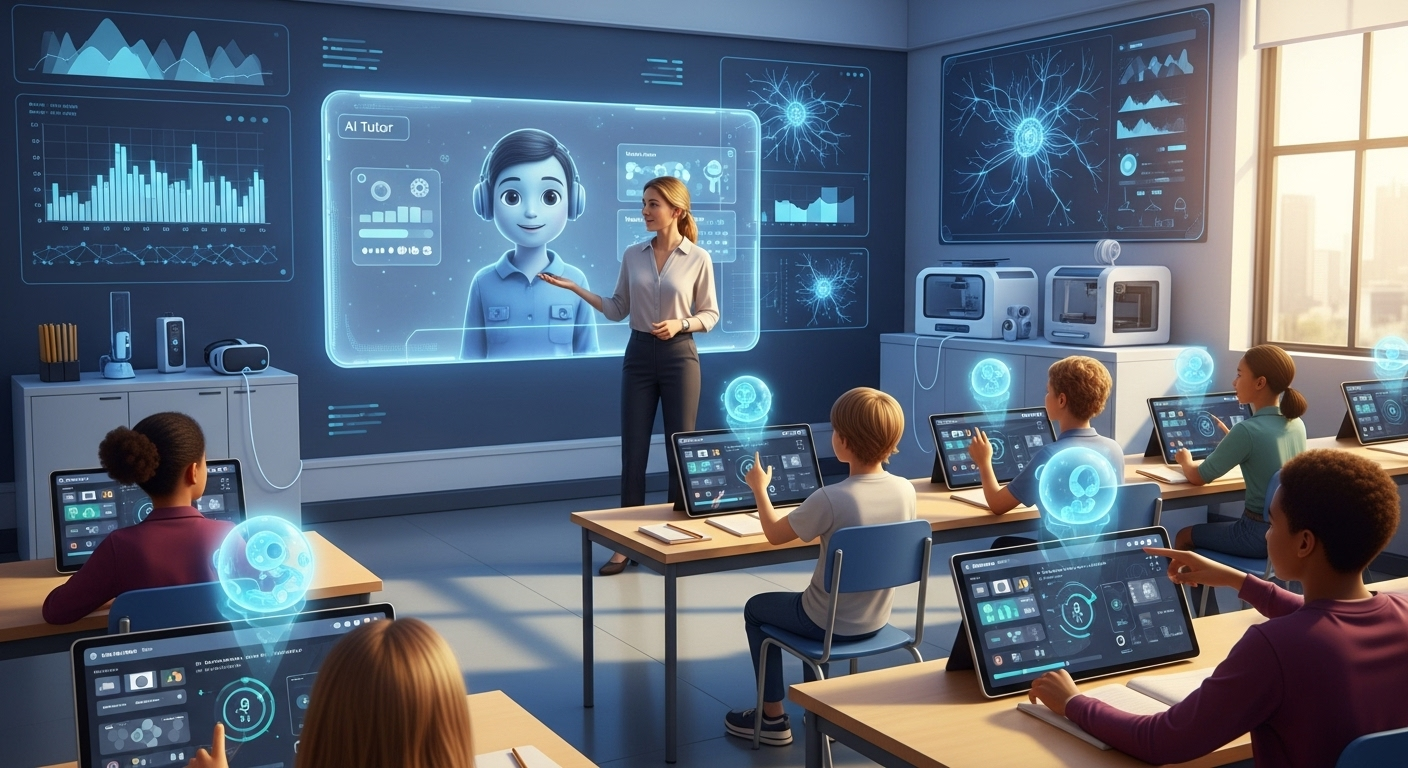
The integration of artificial intelligence into the educational landscape has evolved from a futuristic concept into an everyday reality. Modern classrooms, online universities, and independent learning platforms regularly utilize intelligent tutoring systems and automated assessment tools. These technologies promise unprecedented customization, allowing educational delivery to adapt to the specific pace and style of individual learners while drastically reducing the administrative burden on teachers.
However, this rapid digital transformation brings a complex web of ethical challenges. Because education serves as a fundamental foundation for personal development and societal mobility, the implementation of AI within this sector requires deep ethical scrutiny. Relying heavily on algorithms to teach and evaluate human minds raises vital questions regarding fairness, privacy, human agency, and the very purpose of intellectual development.
Data Privacy and Consent in Vulnerable Populations
The lifeblood of any artificial intelligence system is data. For an AI tutor to customize its math lessons or for an automated grading system to assess an essay, it must collect vast amounts of information. This includes not only correct and incorrect answers but also typing speeds, facial expressions during webcam monitoring, mouse movement patterns, and reading durations.
The ethical dilemma deepens when considering that many users of these systems are minors. Children and teenagers lack the legal and cognitive capacity to fully understand the long-term implications of consenting to data collection. Educational institutions often mandate the use of specific software, meaning students and their parents cannot simply opt out if they harbor reservations about data practices.
Furthermore, data breaches in educational tech companies can expose sensitive behavioral profiles, academic histories, and personal identifiers. This data could potentially follow a student into adulthood, influencing university admissions or career opportunities if accessed by third parties.
Algorithmic Bias and the Perpetuation of Inequality
AI systems are trained on historical data generated by humans, which means they frequently inherit the biases present within that data. In the context of assessment and tutoring, algorithmic bias can manifest in highly damaging ways.
-
Linguistic Bias: Automated essay scoring engines are often trained on standardized samples of writing. These models may disproportionately penalize students who speak English as a second language or those who use regional dialects and cultural expressions that deviate from the training set standard, even if their underlying logic and critical thinking are sound.
-
Socioeconomic Representation: AI tutors built using data primarily from affluent school districts may make assumptions about access to resources, parental support, or cultural reference points that do not align with the realities of low-income students.
-
Proctoring Discrimination: Automated remote proctoring tools designed to detect cheating frequently rely on facial recognition algorithms. These systems have demonstrated higher error rates when identifying individuals with darker skin tones, falsely flagging minor movements or lighting changes as suspicious behavior.
When an biased algorithm determines a student’s grade or limits their access to advanced learning modules, it acts as an invisible barrier, reinforcing systemic educational inequalities rather than dismantling them.
The Loss of Human Connection and Emotional Intelligence
Education is inherently a social and relational endeavor. A human teacher does not merely transmit information; they provide empathy, mentorship, inspiration, and emotional support. A seasoned educator can notice when a student is having a difficult day due to external stressors and alter their instructional approach accordingly.
AI tutoring systems, despite their sophisticated conversational capabilities, do not possess genuine empathy or emotional intelligence. They operate on statistical probabilities and pattern matching. Over-reliance on AI tutors risk isolating students, reducing their opportunities to develop crucial soft skills such as negotiation, collaborative problem-solving, and interpersonal communication.
When students spend the majority of their formative years interacting with software interfaces rather than human peers and mentors, their emotional and social development may suffer. An AI cannot celebrate a breakthrough with genuine joy, nor can it offer authentic comfort during a moment of academic frustration.
Transparency and the Black Box Dilemma
Many complex AI models, particularly deep learning neural networks used in advanced assessment tools, operate as a “black box.” This means that while the input (a student’s exam) and the output (a final grade) are visible, the precise internal logic the algorithm used to arrive at that grade remains obscured.
This lack of transparency violates a fundamental tenet of educational ethics: the right to an explanation. If a human teacher gives a student a failing grade on a history paper, the student can ask for specific feedback, question the grading criteria, and engage in a dialogue to understand their mistakes.
When a black-box AI handles the grading, providing a comprehensive explanation becomes exceedingly difficult. Students, parents, and even the teachers themselves are forced to trust the machine’s verdict without a clear path for appeal. This creates an imbalance of power, leaving students vulnerable to arbitrary or incorrect algorithmic decisions.
Shifts in Academic Integrity and Cognitive Development
The introduction of generative AI as a tool for both learning and assessment has blurred the boundaries of academic integrity. When AI tutors become too helpful, they run the risk of doing the cognitive heavy lifting for the student. If a system provides the answer or structures an essay too quickly rather than guiding the student through the discomfort of productive struggle, it can hinder deep intellectual development.
Simultaneously, traditional methods of assessment, such as take-home essays and open-book exams, are being upended. Educational institutions are caught in an arms race, deploying AI-generated text detectors that are notorious for producing false positives, often misidentifying original work by non-native English speakers as machine-generated text. This environment of mutual suspicion erodes the trust between educators and students, shifting the focus of assessment from demonstrating knowledge to avoiding algorithmic suspicion.
Designing an Ethical Framework for Educational AI
To harness the genuine benefits of AI tutoring and assessment while mitigating these significant ethical risks, educational stakeholders must establish strict guidelines. Technology should serve to enhance human capability, not replace it.
First, the concept of the “human-in-the-loop” must remain mandatory, particularly for high-stakes assessments like final exams, admissions, or placement tests. AI should only serve as an advisory tool, with final grading decisions and disciplinary actions remaining strictly within human purview.
Second, educational technology developers must commit to algorithmic auditing. This involves regularly testing software for bias across diverse demographic groups and ensuring that training data represents a wide spectrum of socio-economic and cultural backgrounds.
Finally, complete data transparency is non-negotiable. Schools must demand clear, plain-language privacy agreements from vendors, ensuring that student data is stripped of personal identifiers, protected with robust encryption, and never sold or used for commercial profiling.
Frequently Asked Questions
Can AI tutors completely replace human teachers in the future?
AI tutors cannot fully replace human teachers because they lack emotional intelligence, genuine empathy, and the ability to mentor students through complex life challenges. While AI can efficiently handle rote memorization, basic skill drilling, and repetitive grading, human educators are essential for fostering creativity, character development, social-emotional skills, and inspiring a love for learning. The future of education lies in a blended approach where AI assists teachers rather than replacing them.
How do AI proctoring tools violate student privacy?
AI proctoring tools often require access to a student’s webcam, microphone, biometric data, and web browsing history. These systems record the student’s private home environment, track their eye movements, and analyze their keystrokes. This level of surveillance can feel highly invasive, causing increased anxiety that can negatively impact exam performance. Furthermore, storing this sensitive biometric and environmental data poses significant security risks if a data breach occurs.
What is a false positive in AI detection, and why is it an ethical issue?
A false positive occurs when an AI detection tool mistakenly flags original, human-written text as being generated by an artificial intelligence model. This is a severe ethical issue because it can lead to false accusations of cheating, resulting in undeserved failing grades, academic probation, or damage to a student’s reputation. Studies have shown these detection tools are particularly unreliable when analyzing essays written by non-native English speakers, introducing a systemic bias.
How can a teacher ensure that an AI grading tool is fair?
Teachers can ensure fairness by using AI grading tools strictly as a preliminary screening method rather than the final authority. An educator should review samples of the AI’s grading across different score ranges to check for consistency and bias. If a student challenges a grade generated by an AI tool, the teacher must conduct a thorough, independent human review of the assignment to provide a transparent and justifiable explanation.
Do AI tutoring tools adapt equally well to all learning styles?
While AI tutoring tools excel at adapting to the pace of learning, they often struggle to accommodate diverse behavioral and cognitive learning styles. Most AI tutors are optimized for text, visual displays, and structured problem-solving. Students who thrive through tactile, kinesthetic, or highly collaborative learning experiences may find AI tutors rigid and ineffective, meaning these tools can inadvertently disadvantage certain types of learners.
How does over-reliance on AI impact a student’s critical thinking skills?
If an AI tutor provides answers too quickly or automatically corrects mistakes before a student has time to reflect, it eliminates the phase known as productive struggle. This struggle is essential for building neurological pathways associated with problem-solving, critical thinking, and cognitive resilience. Over-reliance can create passive learners who depend on an algorithm to structure their thoughts, rather than independent thinkers capable of navigating ambiguity.